

For a Digitally Inclusive and Wellbeing-Oriented Finland
In a rapidly digitalising world, it is essential to ensure that everyone has the opportunity to take part in the change – in a smart and safe way.
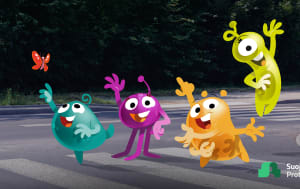
#Onlineroadsafety - Protect Children
Whether they are navigating in the real or virtual world, it’s important that children do not remain alone in an environment which they don’t understand or in which they don’t have the skills to handle its rules and regulations. Adults set an important example to children also in the use of digital medias.
Digital world is a happy and useful environment also for children, as long as they can learn the it and the safety skills it needs safely and peacefully. We support our partner Suojellaan Lapsia/Protect Children in their important work on enhancing children's online safety skills.

Finnish Association for the Welfare of Older People
The Finnish Association for the Welfare of Older People creates a nationwide helpdesk to promote the digital skills and digital inclusion of seniors. The project is called Ikädigituki and it is funded by STEA. DNA supports the project as the main cooperation partner. A free low-threshold service will be created for all types of digital problems and questions that senior citizens may have.

Plan International Finland
DNA and the children's rights organisation Plan International Finland promote digital inclusion and diversity together in joint project. DNA’s main objectives for the cooperation include increasing diversity in its own operations and providing young people with an immigrant background the opportunity to explore the ICT sector as a workplace.
Hope ry
DNA has made an agreement with Hope ry to donate devices for low-income families. DNA’s sponsorship is directed according to the needs reported by Hope and it enables the charity’s work for the benefit of families with limited means.
“Cooperation with DNA has gone smoothly and met the need we have for local assistance. Our humanitarian activities are very concrete, and our cooperation has also offered concrete help in the form of donated devices that make everyday life easier for children and young people whose families would not otherwise be able to afford such devices.”
Eveliina Hostila
Executive Director
Hope - Yhdessä & Yhteisesti ry
Our goal
DNA measures its success by tracking the increase in the number of people trained in digital skills. In 2025, we trained more than 90,000 people in cooperation with our partners. The figure is compiled by combining the number of people trained through our partnership projects with the number of participants in our own training sessions aimed at external audiences.
Children’s Use of Smart Devices
Children’s use of smart devices is a topic that raises a great deal of discussion and concern, both among parents and in society more broadly. At DNA, we also take this issue seriously and work to promote children’s safety in cooperation with our partner, Protect Children Finland (Suojellaan Lapsia ry). This includes, for example, organising workshops for schoolchildren to build digital safety skills.
Our shared recommendation is that, regardless of a child’s age, the most important principle at the early stages of smart device use is to practise using the device together with an adult. The situation can be compared to learning traffic skills: first, the route is practised with an adult, potential hazards and safe crossings are identified, and the rules are reviewed together. It is important for adults to remember that no technology or security settings can fully protect a child online. In addition, we do not recommend independent use of smart devices for children in grades 1–2 of primary school or younger, as their socio-cognitive abilities are not yet sufficient for safe internet use.
If a child is given a smart device, it is important to bear in mind that digital environments and applications are designed to be engaging and captivating—for both adults and children. For this reason, it is essential to find a balance between time spent together and time spent using devices. Children also need adult support in setting limits on smart device use. As early as 2022, DNA launched the nationwide Disconnect Day (Älyvapaapäivä) and, together with Protect Children Finland, developed the Phone Parking concept to help families—especially those with children—take breaks from device use. In addition to practising digital safety skills, it is recommended to equip a child’s device with a service that helps prevent cybersecurity threats, protects the device, personal data and online activity, and enables screen time limits. DNA also always recommends following age rating guidelines.

Latest Achievements

Digital Skills Playing Cards With Plan International Finland
The deck of cards is excellent tool for practicing digital skills, while it has reached more than 60 000 students already.

A Safe Digital Everyday Life Activity Book Sent to 200,000 Homes
DNA and Protect Children (Suojellaan Lapsia ry) have jointly developed an activity book for children aged 5–9 that supports the learning of digital safety skills through storytelling and hands-on activities.

Disconnect Day
DNA launched Disconnect Day in 2022 to remind of the importance of screen-free moments.

Phone Parking to Support Families’ Digital Everyday Life
Digital environments are engaging, enriching, and fascinating – for both adults and children. Still, it is important to find a balance between time spent together and time spent using devices. Phone parking offers a moment of rest both for an overworked phone and for the mind as well.

Governance – Policies
Our work on digital inclusion and wellbeing is guided by our sustainability policies as well as group-level guidelines on responsible partnerships, diversity, and inclusion.

Our Articles
We create easiness and clarity differend kinds of people in this digitalized society.

By our partnerships, we support children, youth and senior citizens, and young immigrants.

DNA conducts annual surveys on themes such as digital inclusion, digital lifestyles, and the digital needs of schoolchildren.